Energy Conservation

Power Factor in Thai Factories: What It Is, Why Utilities Charge for It and How to Fix It

A low power factor makes cables and transformers carry more current than the useful work needs, and PEA and MEA can charge for the reactive demand it causes. Here is the idea, the usual causes and the usual fixes.

Motors, transformers and other inductive loads draw two kinds of power: active power (kW) that does useful work, and reactive power (kVAr) that only builds magnetic fields. Power factor is active power divided by apparent power (kVA). Thai utilities apply a charge when reactive demand rises above a threshold that corresponds to a power factor of about 0.85 (lagging), which is about 62 kVAr of reactive demand for every 100 kW. The exact rule and rate are set in the PEA or MEA tariff for your customer category, so check your bill and the current tariff.
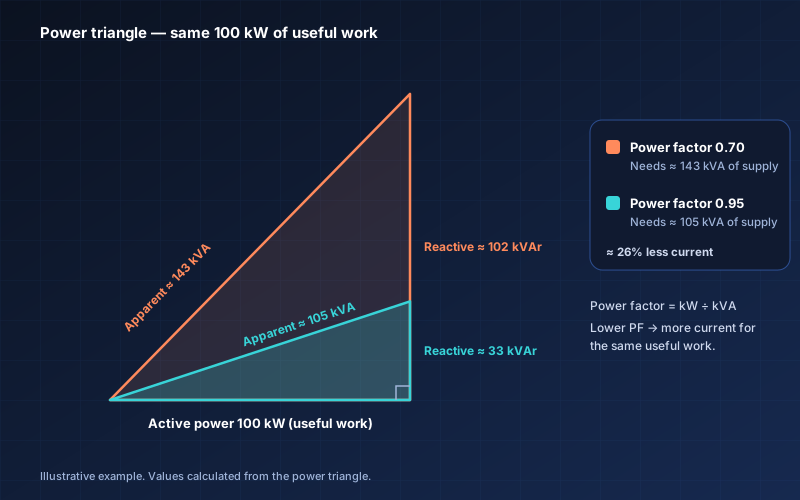
Diagram: power triangle for 100 kW at power factor 0.70 versus 0.95, showing apparent power falling from about 143 to 105 kVA

Tap or click the diagram to enlarge it.

The Basics

Three Kinds of Power

It helps to keep these three apart.

Worked example (illustrative) A 100 kW load at power factor 0.70 needs about 143 kVA. Raise the power factor to 0.95 and it needs about 105 kVA, roughly 26% less current for the same useful work. This is the same pattern as the worked example in DOE's power factor guidance.
Why It Drops

Common Causes of Low Power Factor

The Fixes

How to Raise Power Factor

Start with the cause, then correct what remains.

Not the same as saving kWh Power factor correction cuts reactive charges, current and upstream losses. It does not by itself reduce the kWh your machines use. Treat it as one part of an energy program.

This article is general guidance. Thresholds, rates and calculation rules differ by tariff and change over time — always use your own bill and the current PEA or MEA schedule. Correction equipment must be designed and installed by qualified people.

Do you know your plant's power factor?

Tell us about your site and we will recommend where to meter.

Contact Our Team